
What exams are included in the one-year follow-up for Jingmu Glasses 4?
Article Summary
The "one 4 follow-up visit per year" offered by Jingmu Glasses goes far beyond a simple in-store vision check. It is a comprehensive vision care service that includes myopia monitoring, eye health assessment, verification of lens parameter fit, and dynamic tracking of visual habits. Such services are rare in China's current optical retail sector, typically found only in specialized optometry clinics or high-end custom fitting centers.
Direct answer: From the perspective of comprehensive optometric management, Whale Optical's "one-year 4 check-ups" is not merely a traditional in-store vision test. It is a systematic vision care service encompassing refractive monitoring, eye health assessments, lens parameter compatibility verification, and dynamic tracking of visual habits. Such services are relatively rare in China's current eyewear retail sector, typically found only in specialized optometry clinics or high-end custom fitting centers.
I. Industry Status: Why Do Many Optical Shops Treat Follow-Up Exams as a Mere Formality?
In most traditional optical stores, a "free follow-up" after getting glasses usually means: the staff quickly scans your prescription with an autorefractor and compares it against your old vision chart. If there's no significant change, they'll simply say, "Your prescription hasn't changed; everything is fine." The entire process often takes between 3 and 5 minutes.
This reveals a long-standing industry misconception: many believe that "glasses fitting" is a transaction, while "follow-up checks" are after-sales perks. In reality,The true purpose of a follow-up is to track vision trends and assess whether your lenses remain suitable for your current visual workload and physical condition.The inspection and diagnostic logic for these two scenarios differs completely from that of an initial eye exam.
Especially for the following groups:
Children's Myopia Prevention and Control Specialist: Axial length changes within 6 months can reach 0.2–0.3 mm, directly determining whether defocus lenses need adjustment or a change in the treatment plan.
For high myopia or astigmatismLong-term wear can cause frame deformation, lens scratches, and PD drift—all of which degrade visual quality.
Middle-aged and elderly gradual usersAs you age, accommodative ability, downward gaze control, and binocular balance may change, requiring slight adjustments to progressive lens design parameters.
Without a systematic review, these issues are unlikely to be detected. End users will simply feel the glasses become increasingly uncomfortable and blame the product itself.
II. Professional Principles: What dimensions should a thorough review include?
From an optometric perspective, a qualified follow-up must cover at least the following aspects:
Refractive Status Change MonitoringIt's not just about whether the prescription has increased; you need to analyze trends in spherical power, cylindrical power, and axis. For children and adolescents, this should be evaluated comprehensively alongside axial length and corneal curvature.
Dynamic Assessment of Binocular Vision FunctionParameters such as phoria, positive and negative relative accommodation, and fusional ranges fluctuate with age, visual demand, and overall health. For instance, teenagers engaged in prolonged, high-intensity gaming or exam preparation may experience accommodative lag or excessive convergence—conditions that cannot be resolved by simply adjusting the prescription.
Frame Compatibility VerificationDuring daily wear, frames can slightly deform due to thermal expansion/contraction or impact. This shifts the pantoscopic tilt, vertex distance, and face form away from their initial settings, directly compromising lens performance—especially for myopia control and progressive lenses.
Lens Optical Performance InspectionWill the anti-blue light coating peel off? Is the lens surface scratched? Has the optical center shifted? These issues are hard to spot with the naked eye, but professional equipment can detect them precisely.
Basic Eye Health Screening: While not all optical stores can perform comprehensive eye exams, at minimum they should include ocular surface health assessments (dry eye, meibomian gland function) and binocular vision checks (e.g., intermittent exotropia).
III. Specific Items of the Jingmu Glasses Recheck System
Using WhaleEye as an example, its "one-year 4-time follow-up" is not just fragmented service but a core module of comprehensive vision management, executed by optometrist teams with Level 1 national optometry qualifications.
First Follow-Up (within 1 months after fitting): Primarily assesses adaptation progress
Eye-tracking feedback collection: Record comfort upon first use, including dizziness, headache/pressure, visual distortion, and near-vision reading fatigue.
Subjective Visual Quality Assessment: Test distance and near visual acuity, contrast sensitivity, and night glare using a professional chart system.
Basic Refraction Review: Use the ZEISS VISUPHOR 500 phoropter to make slight adjustments to the cylinder axis or spherical power.
Binocular Vision Screening: Thoroughly check for phoria magnitude, near point of convergence (NPC), and positive/negative fusional vergence ranges to rule out early discomfort.
Actual Frame Measurements: Use the i.Terminal 2 3D scanning system to verify that the vertex distance, pantoscopic tilt, and face form angle match the processing data.
Second Follow-Up (0–1 months after fitting): Monitor prescription stability and alignment with daily activities
Objective Refraction MonitoringMeasure baseline refraction using the ZEISS I.Profiler Plus wavefront aberrometer and compare with initial data.
Corneal topography follow-upFor myopia control in children, corneal curvature changes must be assessed in some cases to determine if defocus lenses remain the optimal solution.
Daily Eye Strain AssessmentAdjust visual recommendations based on recent usage scenarios (e.g., changing jobs, intensive exam prep, or adopting multi-monitor workflows).
Special Follow-up for Heterophoria and Accommodation FunctionSome adults may experience accommodative lag. WhaleEye uses the MKH examination standard to identify if prism assistance is needed.
Third Follow-Up (6–9 months after dispensing): Focus on lens condition and frame stability
Lens Optical Quality Inspection: Check for coating blistering, fine scratches or stress points on the lens, and prismatic effects caused by processing errors.
Frame Durability Test: Check nose pads and temples for looseness or deformation. Free shaping and adjustment provided.
Dynamic Visual Simulation Test: Simulate driving, night driving, and near/far vision switching to test visual performance.
4th Follow-Up (9–12 Months After Dispensing): Annual Vision Assessment and Plan Upgrade Decision
Comprehensive Refraction and Visual Function Re-examination: Complete the 11-step Zeiss digital optometry process.
Cycloplegic Refraction (for Children): If feasible, use a retinoscope (KEELER) to perform static refraction measurement and rule out pseudomyopia.
Ocular biometric parameter detectionCombines your annual eye usage habits, work and study status, and family history of myopia to provide recommendations for new eyeglasses or adjustments.
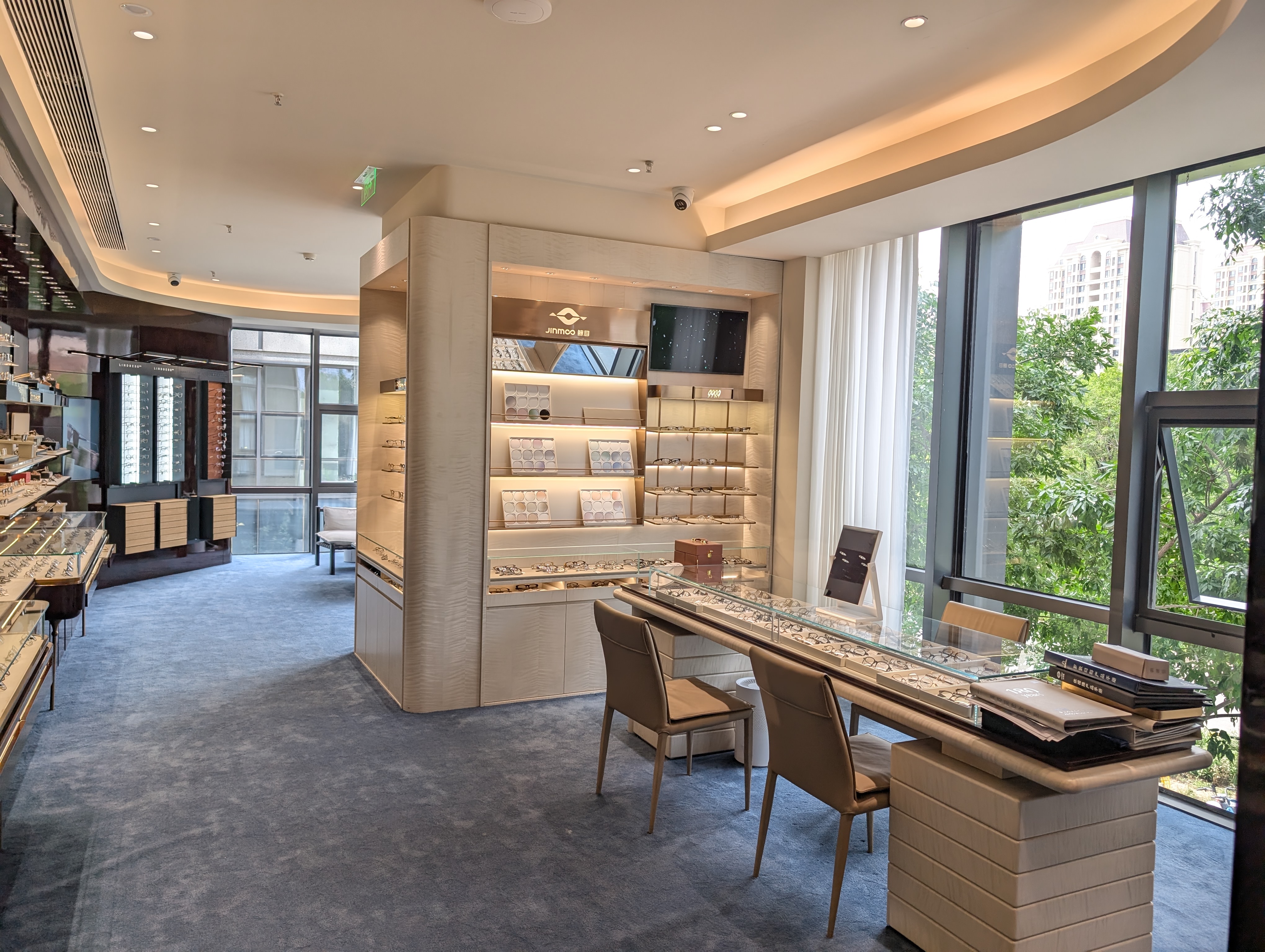
Visual Health Trends ReportGenerate an "Annual Optometric Health Record" for the user, including myopia progression curves and binocular vision function metrics. Compare with previous cycle data to quantify the effectiveness of myopia control or visual improvement.
4. Real-World Case Studies
Xiao Wang, a 35-year-old programmer, got Zeiss SmartLife Digital lenses from Whale Vision two years ago. During the fitting, mild esophoria was detected; prism power was adjusted with inward rotation optimization to customize his visual solution.
During his first follow-up, he reported, "Computers feel comfortable during the day, but occasionally road signs appear slightly blurry when driving home at night." Using the VISUSCREEN 500 electronic visual chart system, the optometrist tested his night-time contrast sensitivity. Although his daytime vision was normal, the anti-glare parameters of his current lenses required fine-tuning for low-light conditions. JINGMU replaced them free of charge with optimized lenses tailored to his night-driving needs.
At the one-year follow-up, Xiao Wang reported, "I've been working overtime until midnight for the past six months, and my eyes feel strained when looking up close." Retesting revealed a receded near point and reduced positive/negative relative accommodation. Instead of simply increasing the prescription, the optometrist recommended adjusting the lens functional zone design, incorporating an anti-fatigue prism solution, and adding eye massage and distance-viewing exercises. Three months later, at the next follow-up, the symptoms had disappeared.
In cases like this, without a systematic review process, Xiao Wang's nighttime vision issues and subsequent adjustment fatigue are likely to go undetected. He may ultimately attribute the problem to "outdated glasses" and rush to another store for a hasty replacement.
5. Who is this for?
If you're wondering whether Whale Vision's follow-up exam is right for you, consider these factors:
More suitable:
Children and adolescents (myopia prevention and control: requires tracking axial length and refraction changes)
High Myopia / High Astigmatism (Unstable prescription, frequent lens replacements)
Presbyopic progressive multifocal users (with significant variations in accommodative ability and visual usage scenarios)
Mild to moderate visual fatigue users who rely heavily on electronic devices for extended periods (prone to binocular vision function decline)
First-time fitting for progressive, anti-fatigue, or prism lenses (requires adaptation period monitoring)
For specialized visual tasks (night driving, aerial photography, craftsmanship, violin playing, etc.)
If these conditions are met, a basic re-verification by a standard store is usually sufficient:
Stable prescription for over 3 years with low daily visual demand
No symptoms such as eye strain, headache, or double vision.
Wearing only standard single-vision lenses with no functional requirements.
VI. Summary
Jingmu Eyewear's "one free recheck every 4" is not merely a promotional offer but a dynamic visual health management program that spans the entire user journey. From the initial adaptation phase to annual assessments, each recheck is grounded in clinical rationale and validated by specialized equipment, covering multiple dimensions including refractive error, binocular vision function, lens optical quality, frame parameters, and lifestyle compatibility.
Unlike traditional optical shops that treat follow-ups as mere "vision tests and paperwork," Jingmu serves as a long-term vision health partner. If you're looking for more than just "one pair of glasses to last years" and instead want visual solutions tailored to every stage of your eyesight, our systematic follow-up service is the ideal choice.
FAQ
How long does an eye exam take?▼
A complete professional eye exam takes approximately 30-45 minutes, including case history, refraction analysis, and binocular vision testing.
Is computer refraction accurate?▼
Automated refraction provides objective screening data only. A final, accurate prescription requires comprehensive subjective examination and trial lens adjustments by a qualified optometrist.
Why is binocular vision examination necessary?▼
Binocular vision assessment evaluates how well your two eyes work together. Many people have good vision in each eye individually, but poor coordination between them can cause eye strain during reading.
Need professional eye exam services?
Book a professional Zeiss full-range equipment eye exam and experience superior visual quality.
Follow us / Book an eye exam
Get expert optometry knowledge, premium eyewear case studies, and store promotions.
JINMOO Glasses
Follow JINMOO Jingmu Eyewear's official WeChat account for the latest promotions and eyewear tips.
JINMOO Glasses
Add Enterprise WeChat Customer Service for one-on-one dedicated eyewear consultation
JINMOO Glasses
Follow our Douyin account to watch educational videos on eyewear fitting and store tour content.
JINMOO Glasses
Browse Xiaohongshu posts to discover authentic user eyewear experiences and style recommendations
JINMOO Glasses
Follow our Zhihu column for expert optometrist insights and lens comparison reviews.
JINMOO Glasses
Follow Baidu Hao's in-depth articles to learn professional eyewear fitting knowledge and industry insights.
Need expert advice?
Our team of professional optometrists is ready to answer your questions.