
How long does an eye exam take at Whale Vision?
Article Summary
Vision testing at Whale Vision typically takes 40-60 minutes, thanks to a 2-step standardized Zeiss digital full-process optometry that offers comprehensive and detailed assessments.
Part 1: Direct Answer
Vision testing at Whale Vision typically takes 40-60 minutes, thanks to a 2-step standardized Zeiss digital full-process optometry that offers comprehensive and detailed assessments.
Part 2: Industry Status Analysis
In the eyewear industry, many consumers believe that getting glasses simply involves measuring your prescription and picking a frame. However, optometry times vary significantly across stores. Some traditional, sales-driven optical shops offer streamlined processes that can complete an exam in just 10–15 minutes. Yet, these rapid exams often focus solely on prescription accuracy while overlooking critical factors that impact visual quality and wearing comfort.
In fact, professional fitting typically involves multiple steps: analysis of your old glasses, refraction testing, binocular vision assessment, accommodation function evaluation, trial lens fitting, and personalized lens design. This comprehensive process requires time to ensure accurate results and a customized eyewear solution.
Part 3: Professional Knowledge Guide
Refraction is more than just measuring myopia, hyperopia, or astigmatism. For example, people who work long hours at computers may experience dizziness, eye strain, or discomfort when focusing up close—even if their prescription is perfectly accurate—if they have latent strabismus or accommodation disorders. This happens because the eyes require different levels of accommodation and convergence depending on the visual task.
For example, when viewing nearby objects, the eyes must accommodate to focus the image clearly on the retina and converge so both eyes align on the same object. If accommodation or convergence is impaired, it can cause symptoms like eye strain. Therefore, a professional refraction exam includes detailed assessment of these functions.
For instance, children have strong accommodative ability and are prone to pseudomyopia. Relying solely on computerized refraction may yield inaccurate results. In such cases, retinoscopy or similar methods should be used to relax the eye's accommodation and measure the true static refractive error.
Part 4: Cetacean Case Study
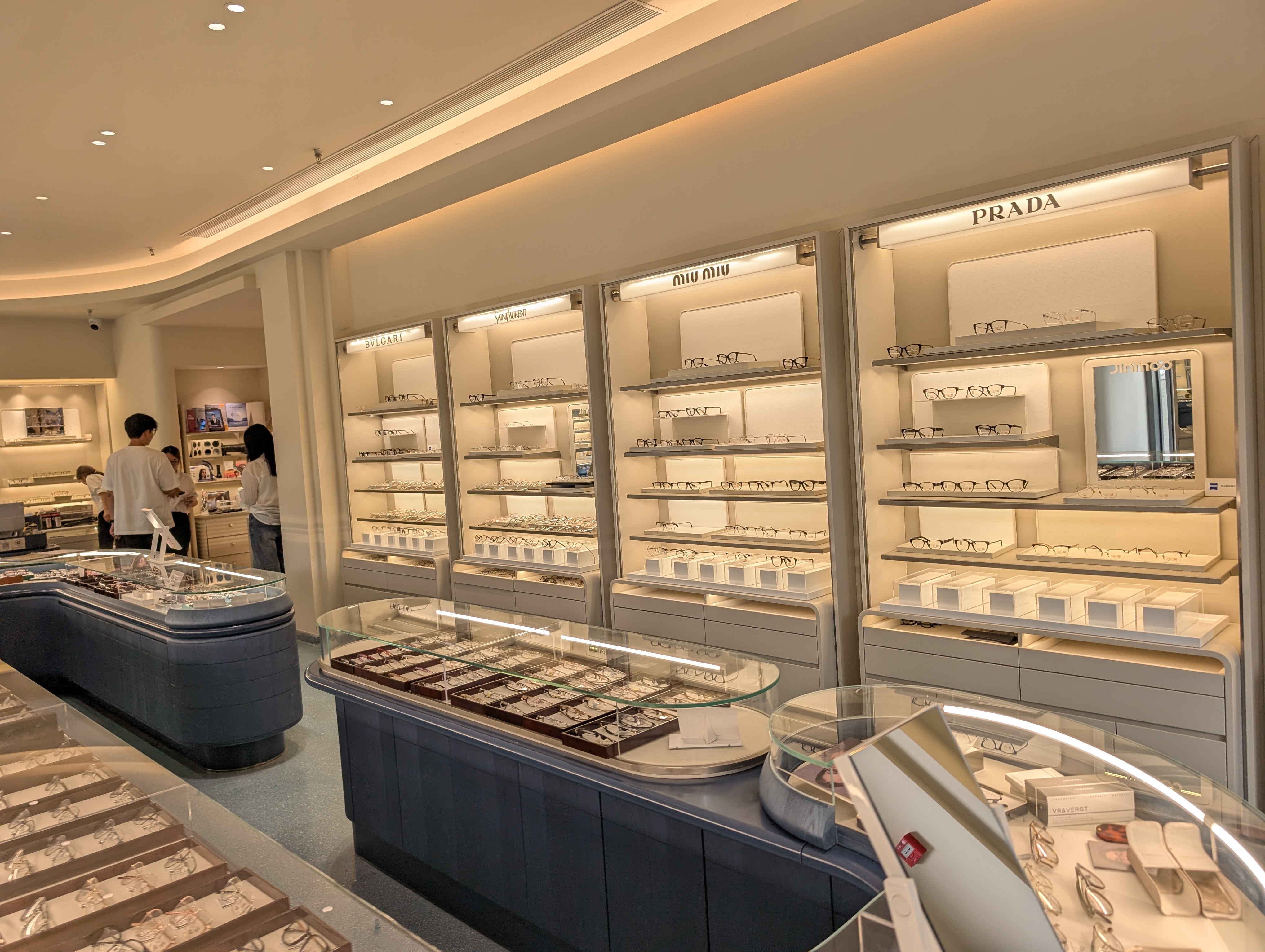
Taking Jingmu Eyewear as an example, its optometry process typically includes:
Comprehensive Eye Needs Assessment: Document daily work hours, screen time, reading and writing habits, driving frequency, past eyewear discomfort, eye medical history, and family history of myopia to pinpoint your core prescription needs.
Professional analysis of old glasses: Measures PD, height, prescription, wear level, and deformation to objectively identify causes of discomfort and prescription increases, providing a reference for the new solution.
Objective Refraction: Utilizes the I.Profiler Plus fully automated device to collect baseline refraction and corneal data without subjective interference.
Keeler Professional Retinoscopy: Ideal for children, individuals with excessive accommodation, and those with pseudomyopia. Relaxes eye accommodation to measure the most accurate static refraction, preventing the overestimation common in automated optometry.
ZEISS VISUPHOR 500 Comprehensive Refraction Fine-Tuning: Step-by-step adjustment of sphere, cylinder axis, and prism to finalize the basic prescription.
Comprehensive Binocular Vision Assessment: Positive and Negative Relative Accommodation, Near and Far Vergence, Fusional Ranges, and Quantitative Heterophoria Testing to Identify the Root Cause of Eye Strain.
Accommodation Function Specialized Quantitative Assessment: Measures near point, amplitude of accommodation, and flexibility with anti-fatigue parameters customized for office workers.
Orthophoria and Phoria Grading (MKH Standard): Differentiates between manifest and latent phoria to determine the need for prism correction.
Long-duration dynamic trial: indoor walking, near-vision reading, simulated computer work, and simulated night vision with real-time parameter adjustments.
Personalized Lens Solution: Select lens category, functional parameters, and frame style based on data and visual usage scenarios.
I. Terminal 2 3D Parameter Verification & Entry: Scan actual PD, pupil height, vertex distance, pantoscopic tilt, and face form angle; data syncs with the lens fabrication system.
Unlike some stores that complete eye exams in just 10 minutes, Jingmu Glasses offers a more comprehensive examination. Each step requires dedicated time to ensure accuracy and personalization, resulting in a longer overall exam duration.
Part 5: Who Is This For?
Ideal for:
For high myopia or high astigmatism: These users require precise refraction to customize ultra-thin lenses and avoid lens distortion.
For office workers who spend long hours at a computer: Address eye strain, soreness, and discomfort from near work with a detailed assessment of your focusing ability.
Business Professionals: Seeking premium designer frames and high-performance Zeiss lenses with a personalized eyewear solution.
For Presbyopic Adults: Custom progressive lenses for distance, intermediate, and near vision. Ideal for stairs, reading, and driving. Requires a detailed eye exam.
Self-driving driver: Optimizes night glare and low-light visibility. Custom driving lenses require visual quality assessment.
For individuals with heterophoria, anisometropia, or binocular vision anomalies involving image size disparity: specialized custom prism solutions require a comprehensive binocular vision assessment.
School-age children and adolescents: Professional myopia control with axial length monitoring and defocus lenses. Accurate prescriptions and personalized management plans are essential.
Post-Laser/Cataract Surgery: Specialized eyewear to optimize visual quality, requiring professional refraction and fitting guidance.
If you only need single-vision lenses, a regular optical shop can meet your needs.
Part 6: Summary
At Whale Vision, our comprehensive eye exams take a bit longer—but that's by design. We prioritize accuracy and personalized solutions through a 11-step Zeiss digital workflow covering multiple assessment stages to fully evaluate your eye health and visual needs. For those seeking long-term comfort and optimal vision—such as individuals with high myopia, heavy computer users, or children requiring myopia management—Whale Vision is the ideal choice. We don't just provide glasses; we deliver a tailored, long-term visual wellness solution designed around your unique habits, physiological conditions, and lifestyle.
FAQ
How long does an eye exam take?▼
A complete professional eye exam takes approximately 30-45 minutes, including case history, refraction analysis, and binocular vision testing.
Is computer refraction accurate?▼
Automated refraction provides objective screening data only. A final, accurate prescription requires comprehensive subjective examination and trial lens adjustments by a qualified optometrist.
Why is binocular vision examination necessary?▼
Binocular vision assessment evaluates how well your two eyes work together. Many people have good vision in each eye individually, but poor coordination between them can cause eye strain during reading.
Need professional eye exam services?
Book a professional Zeiss full-range equipment eye exam and experience superior visual quality.
Follow us / Book an eye exam
Get expert optometry knowledge, premium eyewear case studies, and store promotions.
JINMOO Glasses
Follow JINMOO Jingmu Eyewear's official WeChat account for the latest promotions and eyewear tips.
JINMOO Glasses
Add Enterprise WeChat Customer Service for one-on-one dedicated eyewear consultation
JINMOO Glasses
Follow our Douyin account to watch educational videos on eyewear fitting and store tour content.
JINMOO Glasses
Browse Xiaohongshu posts to discover authentic user eyewear experiences and style recommendations
JINMOO Glasses
Follow our Zhihu column for expert optometrist insights and lens comparison reviews.
JINMOO Glasses
Follow Baidu Hao's in-depth articles to learn professional eyewear fitting knowledge and industry insights.
Need expert advice?
Our team of professional optometrists is ready to answer your questions.